By Courtney Rozen
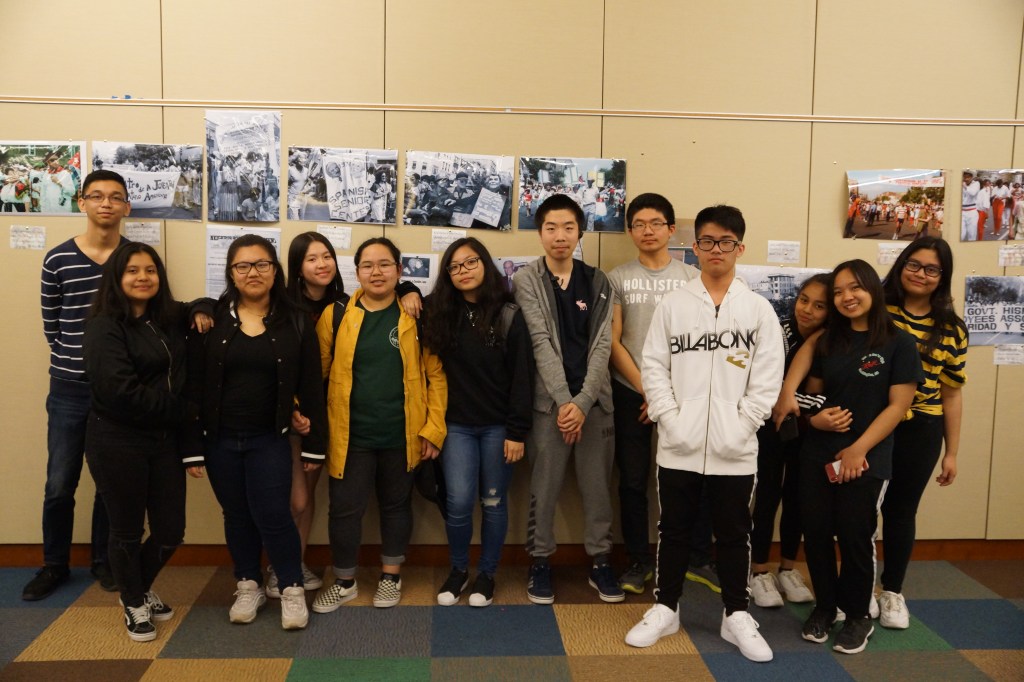
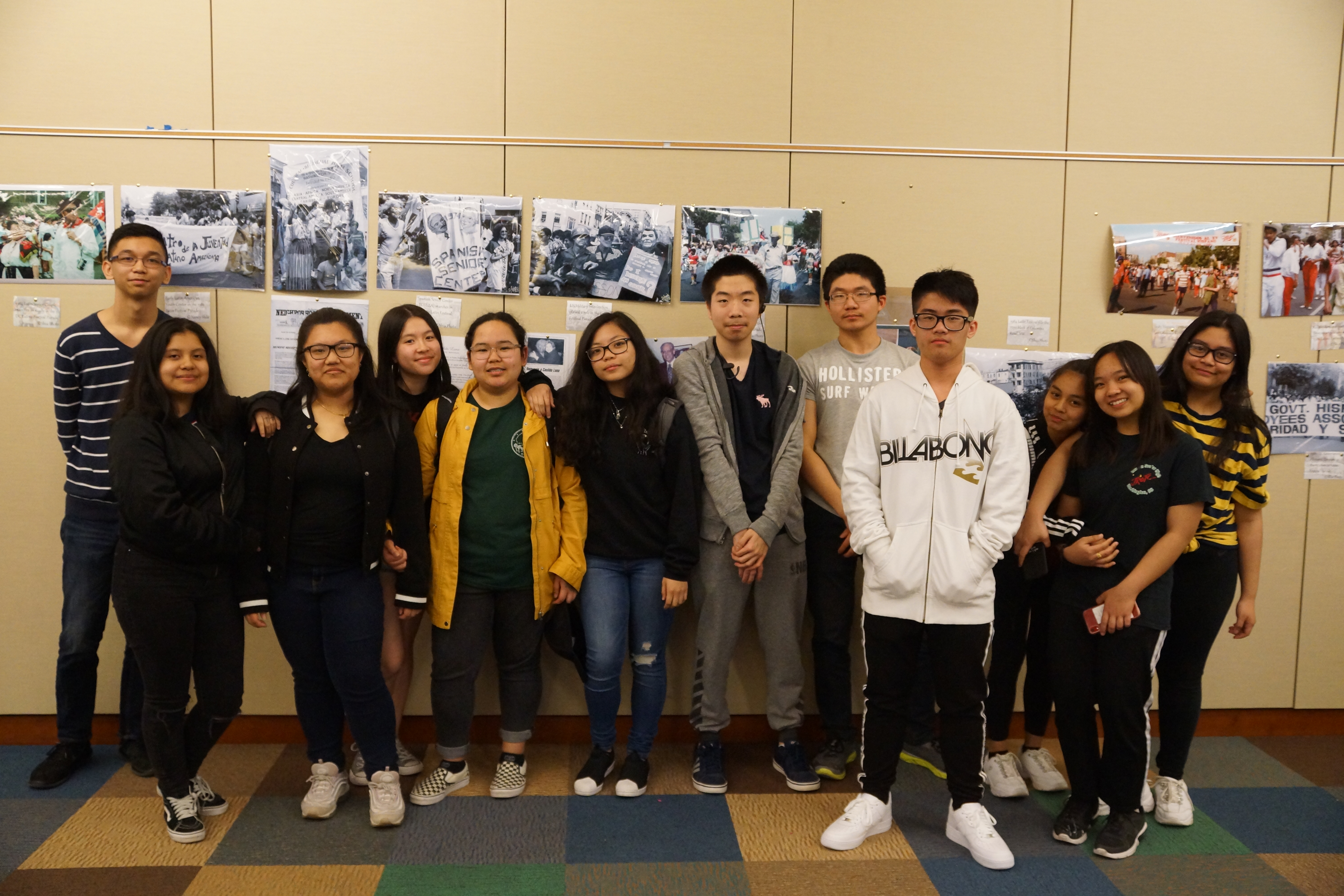
On a Wednesday afternoon in the Mount Pleasant Library, chatter filled the room as a group of low-income Asian American teenagers crafted a set of storybooks for elementary schoolers.
But, the books’ topics were far from childish.
At a card table in the center of the room, Steven and Jason, both sons of Chinese immigrants, wrote a tale about a Filipino female and Chinese male, whose classmates constantly confused them and didn’t learn their individual names. The last names of the high school youth are not included to protect their privacy as minors. AA Lead refers to all members not as students, but as youth.
To Steven, the fictional story is personal. In third grade, Steven’s friends were mostly Asian American. So when Steven raised his hand in class, the teacher regularly called him by an Asian American friend’s name. It hurt that the teacher didn’t see him as an individual, he said.
“You really feel left out, in a way,” Steven said. “And it sort of carries on from there.”
Steven wrote the book as part of an activity for AA Lead, a group for low-income Asian American youth in D.C.
Teens at AA Lead’s D.C. chapter said that being seen as part of a group, rather than as individuals, is a challenge for Asian American youth in the district, who are often one of few Asian Americans in their schools. At the same time, as working-class D.C. residents, AA Lead youth are balancing the challenges of not being affluent in an expensive city.
But at AA Lead, those challenges are embraced and explored, as youth members discuss topics like Asian American stereotypes, history and anti-Asian racism. Teens from across the district travel up to 90 minutes to attend group meetings, hoping to find community with other Asian American teens in the district.
“I think that’s something that they definitely don’t get at their schools: being able to talk about themselves, and their own experiences,” said Aaron Orpilla, AA Lead’s D.C. middle and high school programs coordinator.

AA Lead members Diane and Maricarmen. Photo courtesy of AA Lead.
When Alessandra, 17, first moved to the U.S. from the Philippines in 2015, she quickly noticed how lenient her classmates’ parents were. Her parents are “conservative,” she said, and strict about where she spent her time outside of school.
“When I came here, I was like, should I conform in what American students do, or should I stay and just do what I’ve learned within my family and the Philippines?” Alessandra said.
In the eyes of the U.S. government, Alessandra joined the Asian American community when she moved to the U.S. The U.S. government defines Asian Americans as people with origins in the Far East, Southeast Asia or the Indian subcontinent, according to the Asian Pacific Institute on Gender-Based Violence. That means more than 40 countries fall under the umbrella of Asian American, each with different cultures, languages and religions. At AA Lead, for example, 23 Asian ethnic groups are represented, with the most popular groups being Chinese, Vietnamese and Filipino, according to AA Lead’s 2018 annual report.
“I often point out, we have literally been at war in our home countries,” said Helen Hsu, president of the Asian American Psychological Association. “But in the U.S., we became an identity because we were lumped together by external forces, and we have at least enough cultural similarities that we found ways to sort of bond, and have a collective voice.”
In D.C., 3.8% of the population identifies as Asian American, according to the D.C. Office of Planning. The most popular ethnicities are Chinese and Asian Indian, according to a 2017 report by the Mayor’s Office on Asian and Pacific Islander Affairs.
Growing up as one of the only Asian Americans in a community can lead to racial or emotional trauma, Hsu said. In her role as an Asian American specialist and staff psychologist at Stanford University, Hsu has worked with students who are traumatized because they were mocked as a child, or are “emotionally exhausted” because others constantly view them as foreigners, despite being born in the U.S., she said.
AA Lead’s goal is to create a space where Asian American youth have a sense of community and belonging, where they “really feel affirmed in their identity,” said Charles Kuo, AA Lead’s D.C. programs manager. At school, for example, lessons about race are often restricted to conflicts between blacks and whites, or whites and Native Americans, Steven said, even though Asian Americans also experience racism. At AA Lead, they talk about Asian American history and culture, supplementing what youth learn in school with lessons about their own heritage.
“My friends [at school] are like really interested in it, too, when I talk to them about my culture,” Stephanie said. “But on the other hand, it’s great that you understand, but it would even be better if you were like me.”

Despite myths about the financial success of the entire Asian American community, the wealth gap among Asian Americans in the U.S. is actually larger than that among whites, according to a 2016 report from the Center for American Progress.
In a 2017 report, the Mayor’s Office on Asian and Pacific Islander Affairs said that 15% of Asian American and Pacific Islanders (that’s another term that the U.S. Census used to use to group together people of Asian, Asian American and Pacific Islander ancestry) in D.C. were below the poverty level in the last 12 months.
But looking at the economic wellbeing of the Asian American community as a whole can be misleading, said Sanjana Quasem, a program manager at the Asian American Health Initiative in Montgomery County. That’s because there are variations in income levels between Asian American subgroups. In Montgomery County, for example, the poverty rate for Asian American families with children under 18 is 4.9 percent. But, the poverty rate for the same Burmese American families, a subgroup of Asian Americans, is 13.9 percent. For Pakistani families with children under 18, it’s 13.4 percent. Still, non-Asian Americans often perceive the whole Asian American community to be wealthy, calling them the “model minority,” said Yuanlong Dai, a former member of AA Lead who is now a student at Emory University in Atlanta.
That’s not the case at AA Lead, where members often qualify for free and reduced meals at school, Kuo said. For youth that live in a household of four people, that means their families make less than $46,435 per year. AA Lead also uses income guidelines from the U.S. Department of Housing and Urban Development to determine whether youth qualify as low-income and can join the group. For a family of four, for example, youth from families making less than $77,450 per year can join.
Like other low-income Washingtonians, the rising cost of housing in D.C. is also a challenge for the families of AA Lead youth. AA Lead staff are having trouble finding low-income Asian American elementary schoolers to join their D.C. programs, Kuo said, while their Virginia and Maryland programs are growing. At one D.C. elementary school, for example, most of the students in their program are Latin American.
“Growing up, from elementary to middle school to now, they’re noticing a lot of their friends moving out and not really having an answer for that. Why is my friend, who lived two apartments away from me, suddenly gone?” Kuo said.
As the week’s AA Lead session ended, the high school youth wrapped up their storybooks. It’s been more than a decade since Steven joined AA Lead. He’s now a high school student at School Without Walls, where he takes college-level classes. Steven said that he finds that other races still clump Asian Americans together, instead of seeing them as individuals. AA Lead taught him to embrace his “Asian-ness,” rather than “letting it go and conforming,” he said.
“If my third grade teacher went to AA Lead, they probably would never remember every person’s name, because our skin tone is almost the same,” Steven said. “It’s recognizing everyone is unique in their own way. We just share appearance that looks the same, but we are actually different.”
 Courtney Rozen